The question
Which algorithms can move between Ising platforms, and where does the hardware change the algorithm itself? This review uses a co-design perspective to connect problem encoding, sampling methods, capacity limits, variational optimization, and generative AI. Its four figures form a map of those connections.
Begin with the algorithm–hardware loop.
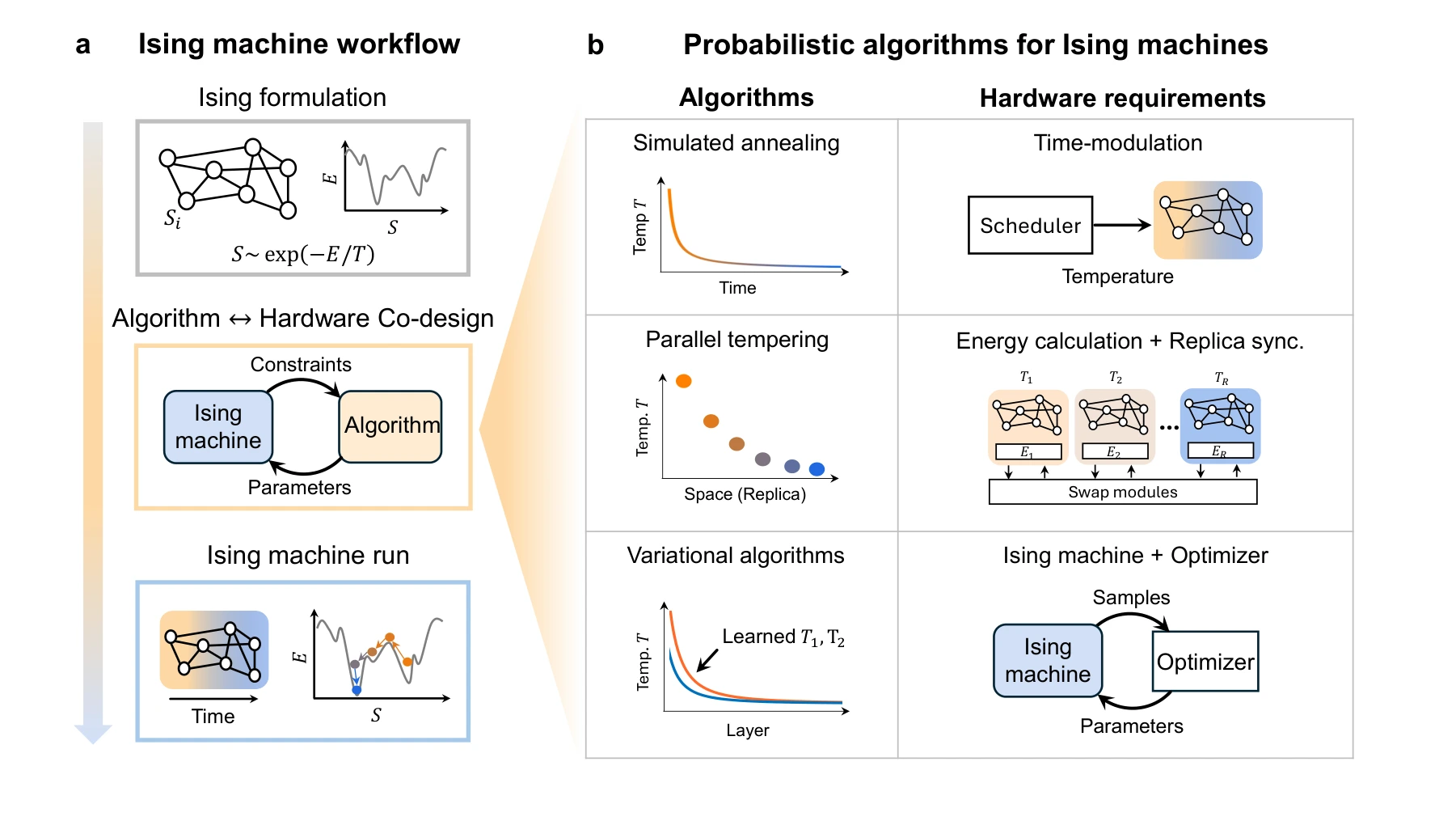
A task is encoded as an Ising energy landscape, an algorithm drives exploration, and samples are evaluated against the original objective. Hardware capabilities constrain this loop while new algorithms create demands for different hardware features.
Panel (a). The task is encoded as an energy function before the machine explores configurations. Hardware constraints and algorithmic requirements feed back into one another, so the workflow includes both problem formulation and physical execution.
Panel (b). The three algorithm families place different demands on hardware: annealing needs temperature scheduling, tempering needs replica exchange and energy calculations, and variational methods need sampled feedback to a classical optimizer.
Work beyond the capacity of one chip.
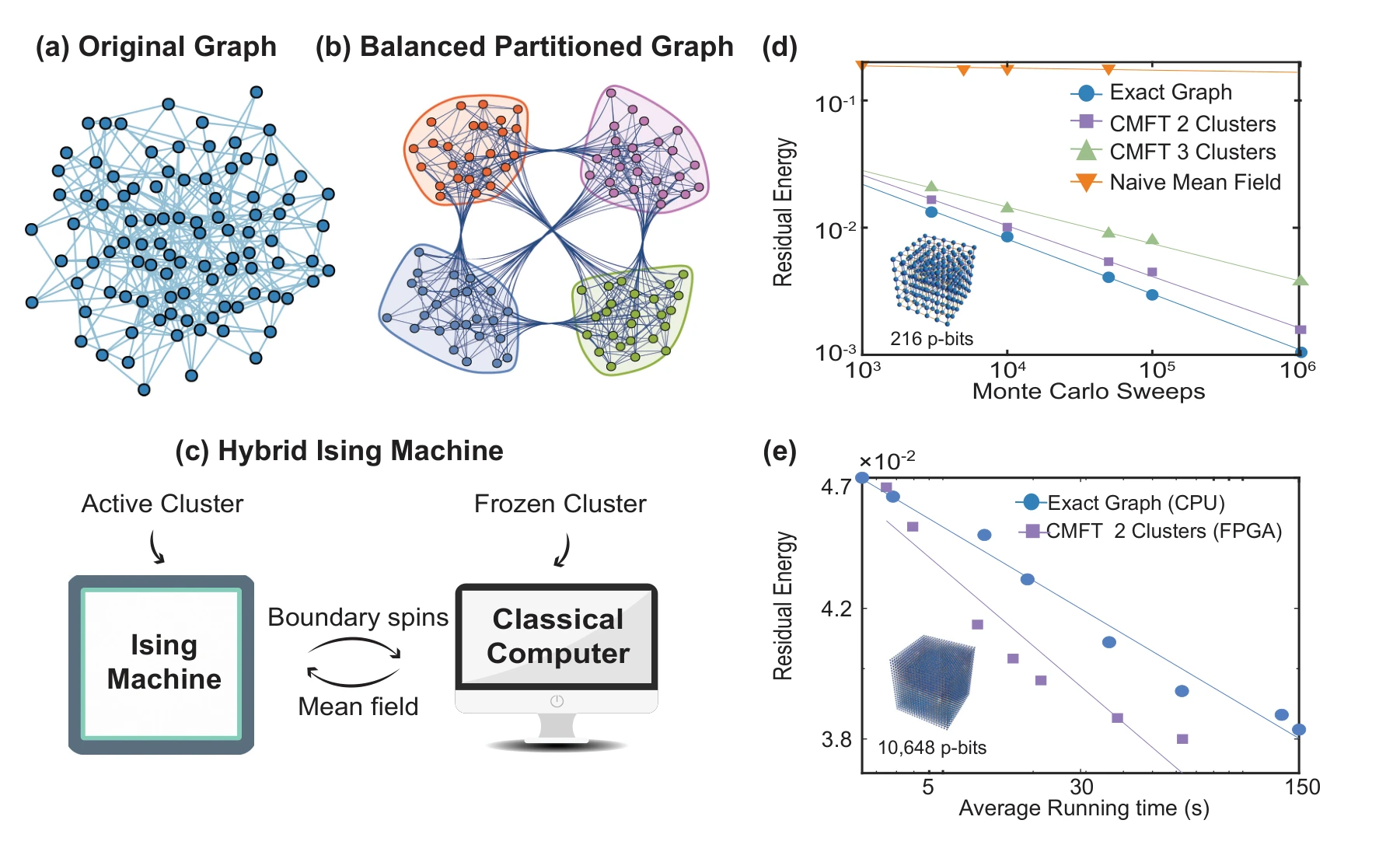
Cluster mean-field methods partition a large interaction graph into hardware-sized pieces. The figure contrasts serial and parallel updates, showing how classical processing approximates interactions at the boundaries between clusters.
Panels (a)–(c). The interaction graph is partitioned into hardware-sized clusters. An active cluster is updated while the remaining clusters are frozen, and a classical processor approximates interactions across their boundaries.
Panels (d) and (e). CPU curves compare convergence as the cluster count changes. The FPGA comparison then tests a larger problem than one device can hold, separating a capacity-scaling method from a claim about arbitrary partitioning being equally effective.
Make the stochastic trajectory variational.
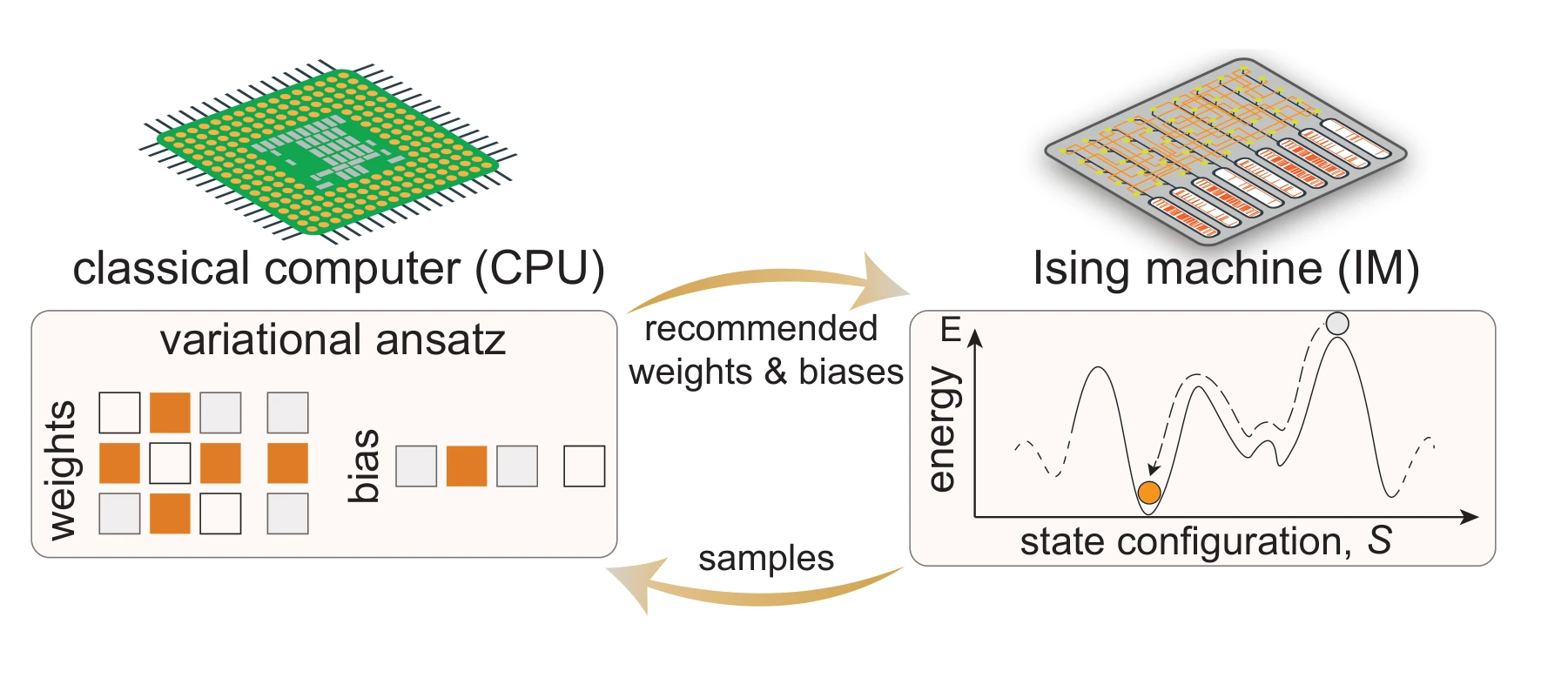
PAOA adds a learnable layer to the workflow. Costs estimated from samples update effective couplings, fields, or schedules, creating a sequence of stochastic dynamics adapted to the optimization problem.
The two sides of the loop. The CPU evaluates the sampled objective and changes variational parameters. The Ising machine returns states under those parameters; repeating the exchange learns a non-equilibrium trajectory rather than assuming a fixed thermal distribution.
Connect generative models and Ising machines.
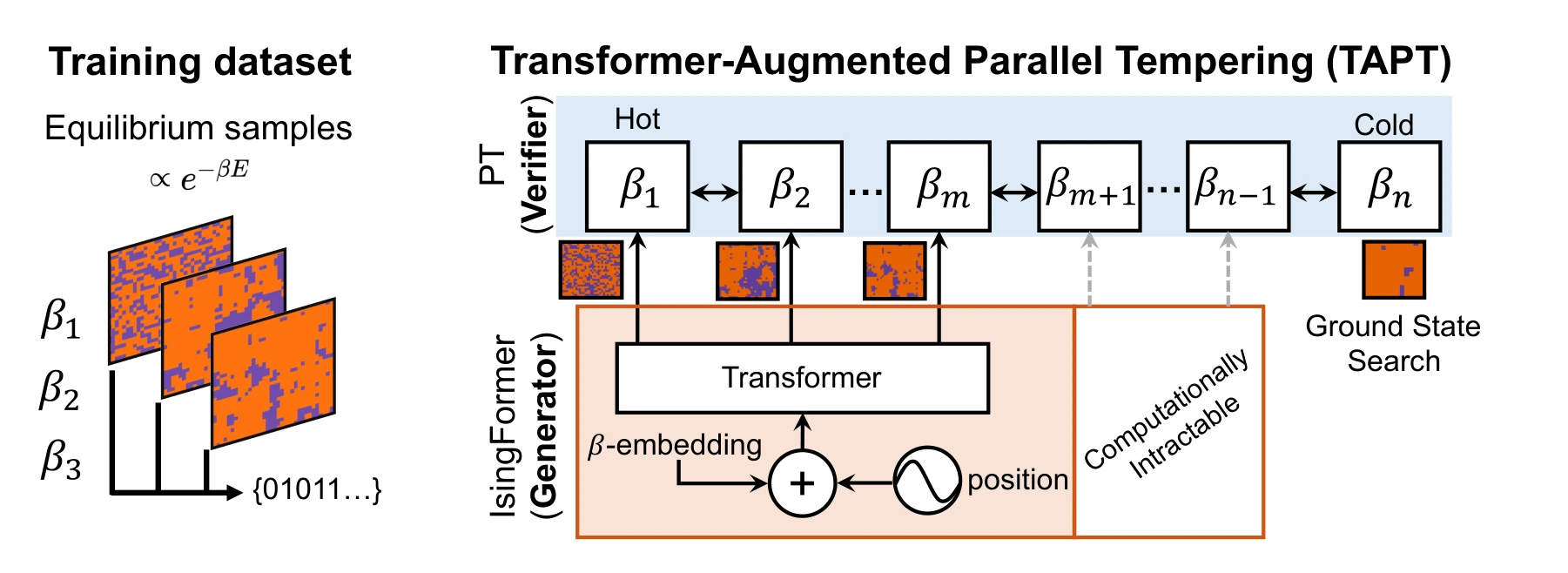
The relationship works in both directions: samples from probabilistic systems can train generative models, while learned models can propose global configurations for search. The generator–verifier view helps distinguish proposing a candidate from evaluating its quality.
Training and search. The left side supplies temperature-indexed MCMC data for the generator. The right side inserts complete generated configurations into a tempering search, where proposal evaluation and replica exchange remain necessary. The acceptance rule determines whether the resulting process is suitable for equilibrium sampling or optimization.
Putting it together
A common language across platforms.
The figures move from the basic workflow to capacity scaling, learned dynamics, and generative proposals. Together they explain why probabilistic computing benefits from developing algorithms and physical implementations in conversation with one another.
Citation
Delacour, C., Zhang, X., Abdelrahman, A. S., Bunaiyan, S., Lee, K., Chowdhury, S., & Camsari, K. Y. Probabilistic algorithms for Ising machines from optimization to generative AI. Nature Reviews Electrical Engineering (2026). https://doi.org/10.1038/s44287-026-00344-0
BibTeX
@article{delacour2026probabilistic,
  title = {Probabilistic algorithms for Ising machines from optimization to generative AI},
  author = {Delacour, Corentin and Zhang, Xiuqi and Abdelrahman, Abdelrahman S. and Bunaiyan, Saleh and Lee, Kyle and Chowdhury, Shuvro and Camsari, Kerem Y.},
  journal = {Nature Reviews Electrical Engineering},
  year = {2026},
  doi = {10.1038/s44287-026-00344-0}
}