The question
Can a stochastic neuron be designed as reusable parts rather than a tightly coupled circuit? This work separates the source of randomness from the input and activation paths. The figures develop the architecture, demonstrate configurable responses, and test how sharing stochastic units affects a digital implementation.
Separate randomness from the input path.
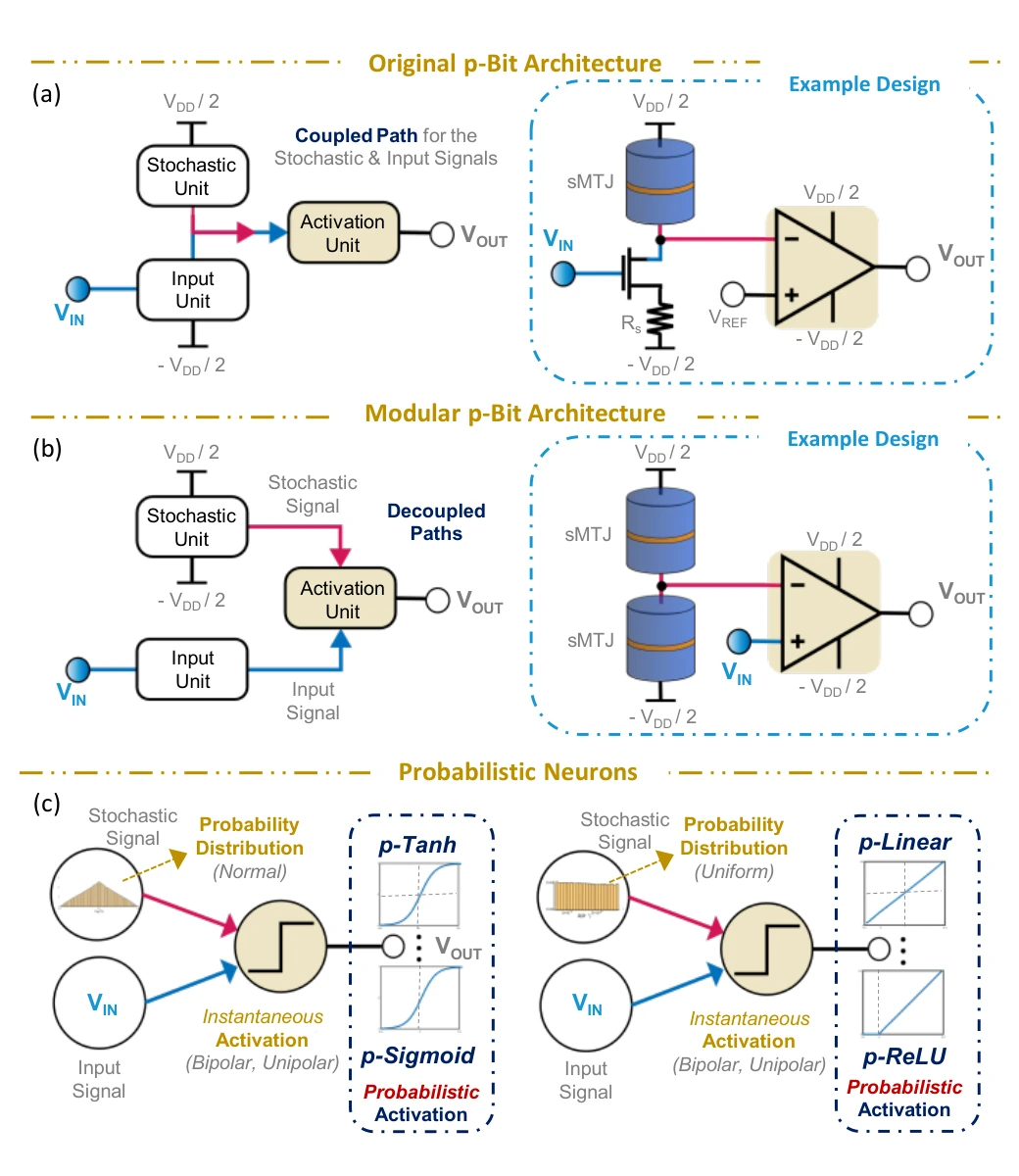
The opening architecture contrasts a coupled p-bit with a modular design. Decoupling the stochastic and activation units makes it possible to change the neuron response without rebuilding the entire source of randomness.
Panel (a). In the original architecture, the stochastic element and input path meet within the same circuit. Changing the random source or its response can therefore also affect how the input is processed.
Panel (b). The modular architecture separates the stochastic unit from the input and activation paths. The dual-sMTJ example supplies randomness to a distinct activation circuit, giving the designer separate choices for these two functions.
Panel (c). The lower diagrams connect a random-variable distribution and an instantaneous activation function to the time-averaged neuron response. The point is configurability: different combinations can produce probabilistic tanh, sigmoid, ReLU, or linear behavior.
Build several activation functions.
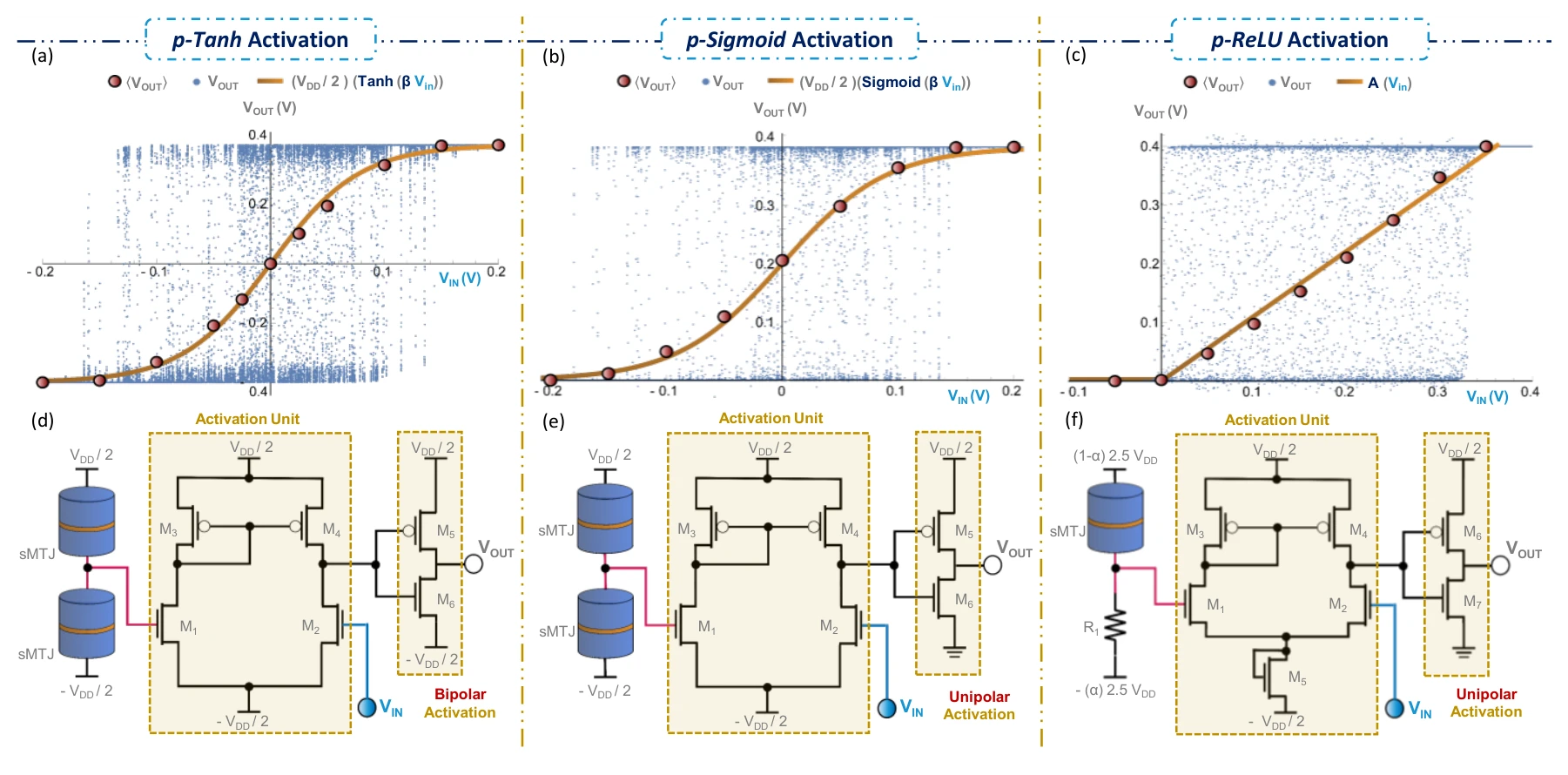
Spintronic circuit examples implement probabilistic versions of tanh, sigmoid, and ReLU. Instantaneous outputs and time-averaged responses connect transistor-level designs to the activation functions they realize.
Panels (a)–(c). Instantaneous responses and time averages are shown separately for probabilistic tanh, sigmoid, and ReLU neurons. The average activation is the quantity to compare with the intended nonlinear function.
Panels (d)–(f). The corresponding transistor-level designs change the activation circuit and stochastic unit. Comparing each circuit with the response directly above it connects the modular design choices to the measured behavior.
Engineer the distribution of the stochastic unit.
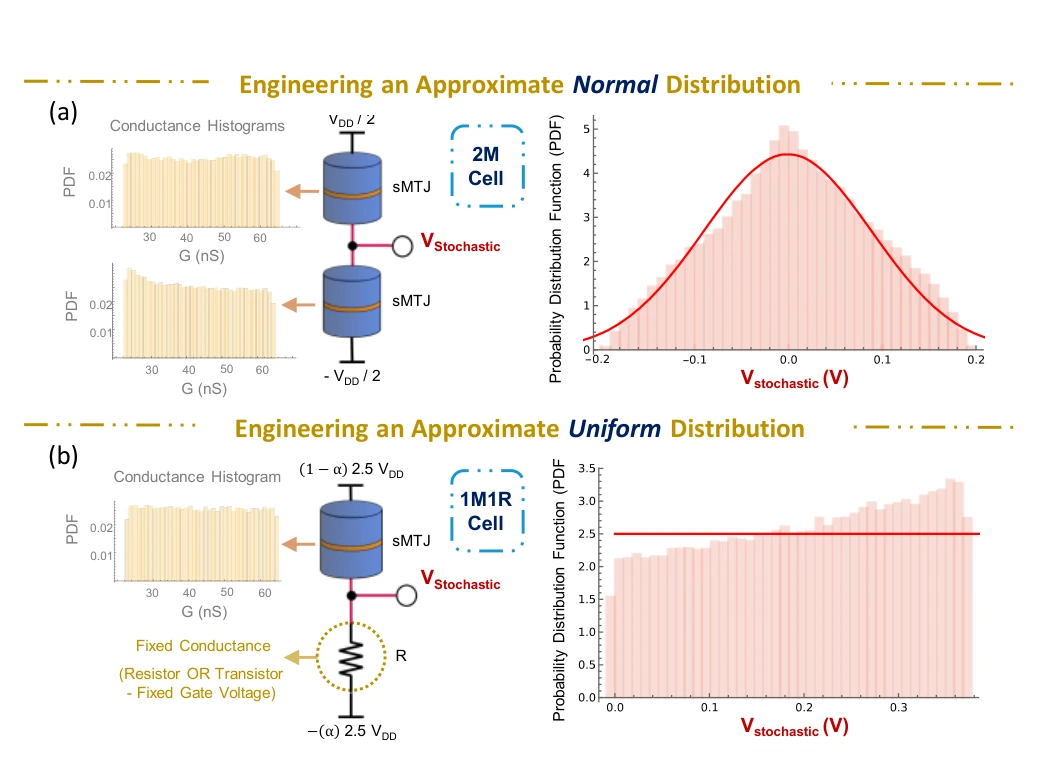
Different stochastic-unit constructions produce different voltage distributions. The normal-like and uniform-like examples show how this module can be selected to support the desired probabilistic activation.
Panel (a). Two stochastic magnetic tunnel junctions form a voltage divider. The conductance histograms on the left describe the individual elements; the voltage histogram on the right shows the approximately normal distribution produced by the combined stochastic unit.
Panel (b). Replacing one junction with a fixed resistor changes the output distribution to approximately uniform. Comparing the two rows shows why the stochastic unit is a design choice: its distribution helps determine the neuron’s eventual activation function.
Tune the range of probabilistic behavior.
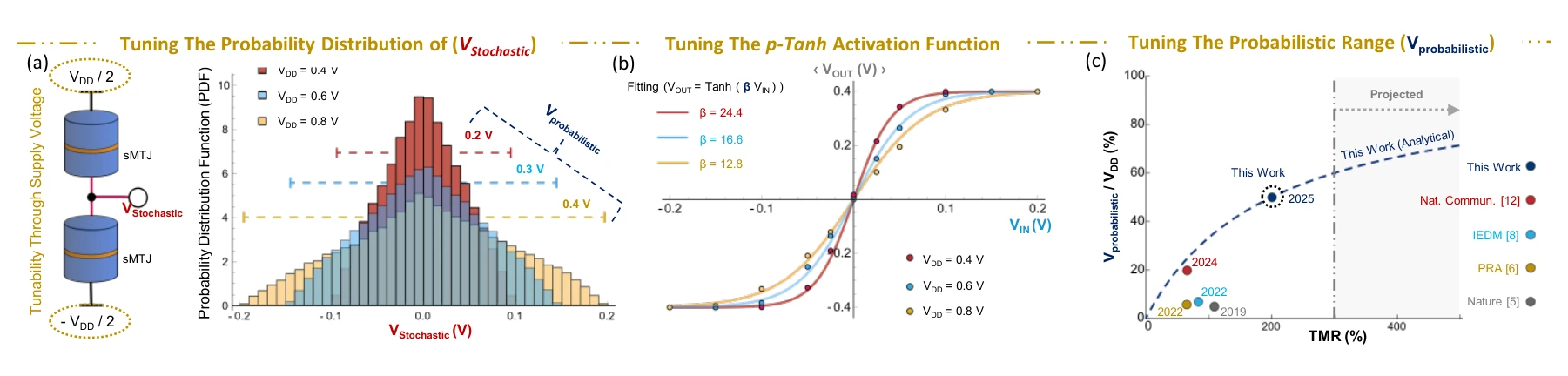
The response is not fixed by the architecture alone. Supply conditions and device characteristics change the transition range, providing circuit-level controls over the resulting activation function.
Panels (a)–(c). Supply voltage tunes the stochastic distribution, β scales the tanh response, and the final plot relates the available probabilistic range to tunneling magnetoresistance.
Test modularity on digital hardware.
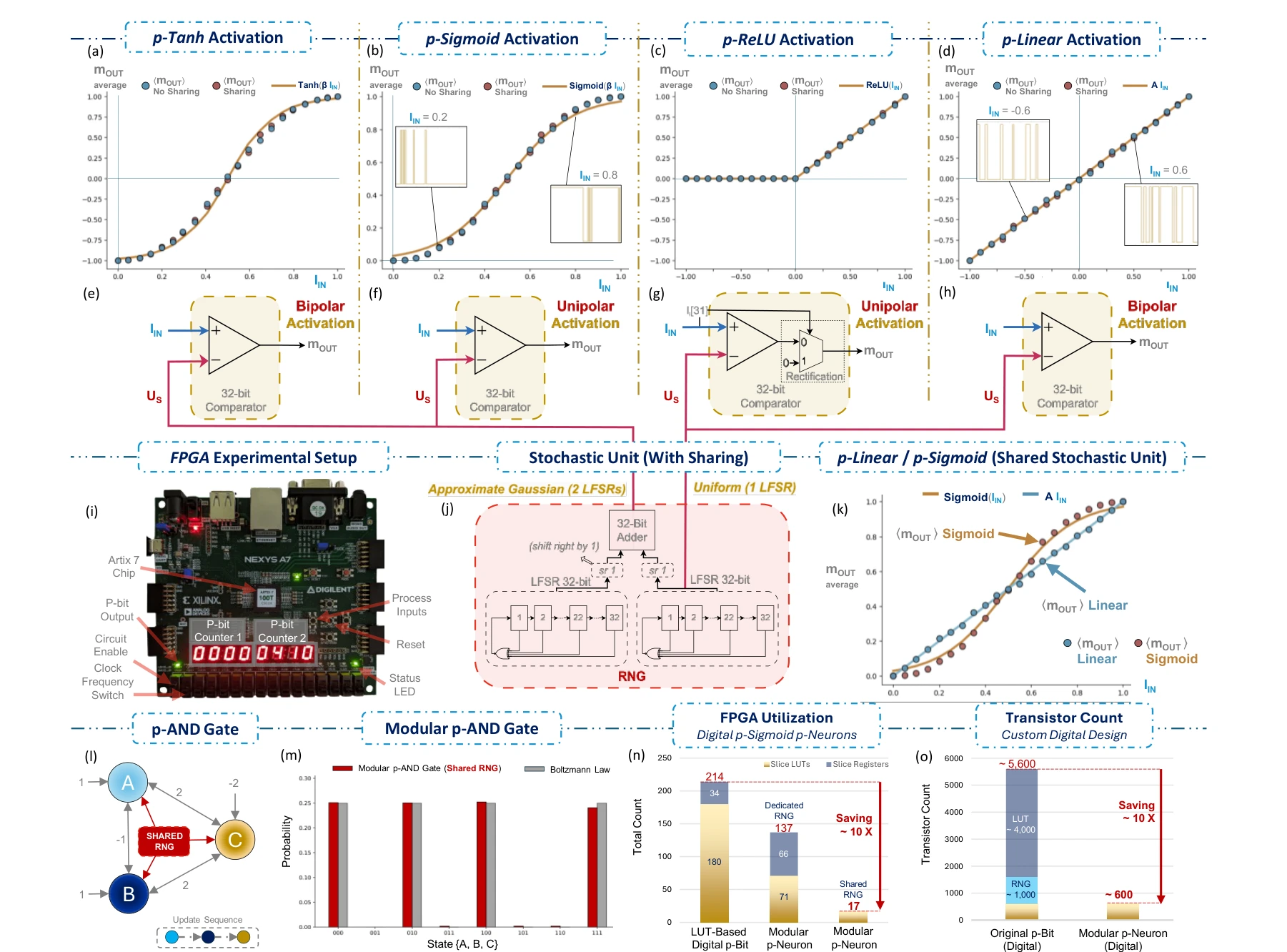
FPGA experiments realize several activation functions and examine stochastic-unit sharing. A small p-AND network checks functional behavior, while resource comparisons show the hardware implications of sharing the random-number source.
Panels (a)–(h). The first four panels show measured average responses for digital tanh, sigmoid, ReLU, and linear neurons. The corresponding designs underneath compare a digital input with a random number supplied by the stochastic unit.
Panels (i)–(m). The hardware photograph and sharing diagrams connect those responses to FPGA experiments. The p-AND example uses three neurons sharing one random-number source; its state histogram is compared with the expected Boltzmann distribution.
Panels (n) and (o). Resource-utilization and transistor-count comparisons quantify the architectural motivation. Read these alongside the sharing experiments: the reduction comes from reusing stochastic resources, while each neuron retains its own activation path.
Putting it together
Modularity as a circuit design tool.
Separating the stochastic and activation paths creates configurable building blocks. The digital experiments connect that modularity to functional networks and reduced hardware resource requirements.
Citation
Bunaiyan, S., Alsharif, M., Abdelrahman, A. S., ElSawy, H., Cheema, S. S., Fahmy, S. A., Camsari, K. Y., & Al-Dirini, F. Configurable p-Neurons Using Modular p-Bits. IEEE International Symposium on Circuits and Systems (ISCAS) (2026). https://doi.org/10.1109/ISCAS66217.2026.11562319
BibTeX
@inproceedings{bunaiyan2026pneurons,
  title = {Configurable p-Neurons Using Modular p-Bits},
  author = {Bunaiyan, Saleh and Alsharif, Mohammad and Abdelrahman, Abdelrahman S. and ElSawy, Hesham and Cheema, Suraj S. and Fahmy, Suhaib A. and Camsari, Kerem Y. and Al-Dirini, Feras},
  booktitle = {2026 IEEE International Symposium on Circuits and Systems (ISCAS)},
  year = {2026},
  doi = {10.1109/ISCAS66217.2026.11562319}
}