The question
The minimum-variance portfolio depends on an inverse covariance matrix, which can amplify estimation noise. This paper reformulates the weights and adapts the regularization parameter to the observed returns. Two data experiments examine the resulting realized risk across training-window lengths and added noise levels.
Evaluate realized risk on the first asset set.
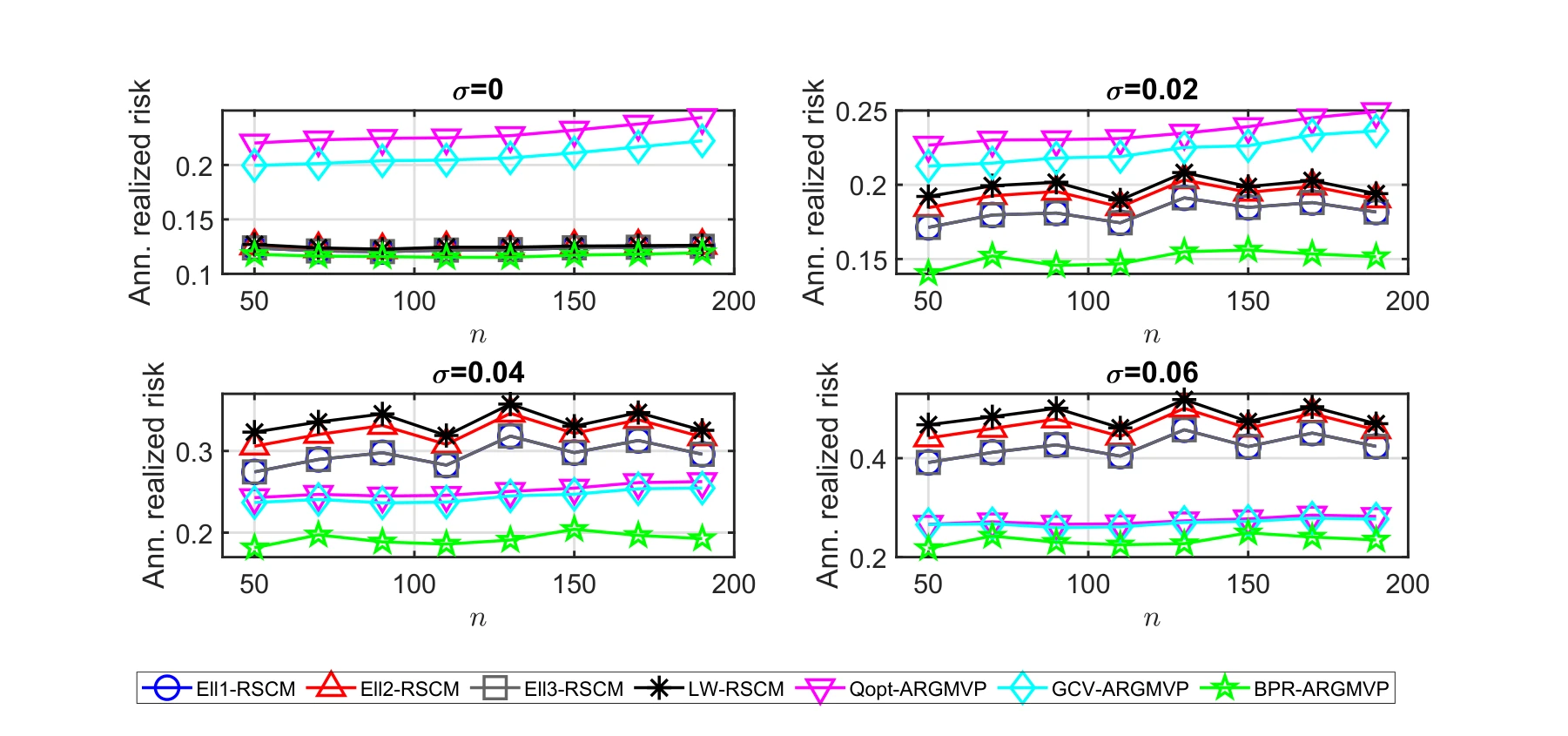
The first experiment uses 45 Hang Seng Index assets observed from 2010 to 2011. Each panel varies the added noise level, comparing annualized realized risk across training-window lengths and competing covariance-regularization methods.
The four plots. The panels add Gaussian return noise with standard deviations 0, 0.02, 0.04, and 0.06. Each plots annualized realized risk against the training-window length for the 2010–2011 asset set.
What to compare. Lower risk is the evaluation criterion. Comparing methods at the same window length and noise setting tests sensitivity to noisy returns, rather than comparing different training histories.
Repeat the comparison on a second period.
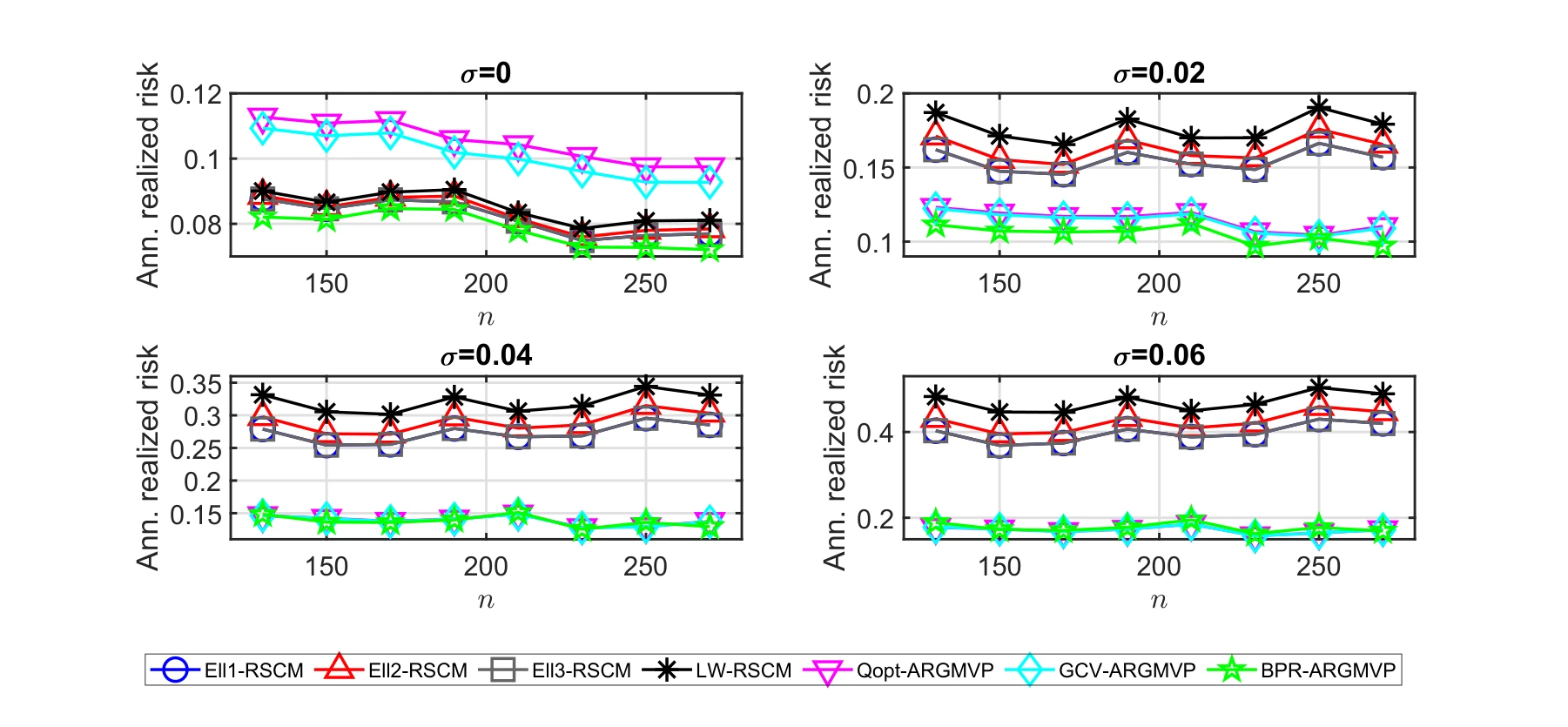
A second experiment uses 50 Hang Seng Index assets from 2016 to 2017. Repeating the noise and training-window comparisons checks whether the behavior carries over to a different asset set and time period.
A second dataset. The same four noise settings are evaluated on the 2016–2017 period with 50 assets. The repeated design checks whether the pattern from the earlier period persists on another dataset.
Reading the curves. Compare methods within each panel before comparing noise levels. These are realized-risk results for the tested historical datasets, rather than a guarantee about future portfolio performance.
Putting it together
Adapt the estimator to the observations.
The figures evaluate the proposal through out-of-sample realized risk rather than matrix estimation alone. The central idea is to make the regularization parameter respond to the data used to construct the portfolio.
Citation
Ballal, T., Abdelrahman, A. S., Muqaibel, A. H., & Al-Naffouri, T. Y. An Adaptive Regularization Approach to Portfolio Optimization. ICASSP - IEEE International Conference on Acoustics, Speech and Signal Processing, 5175-5179 (2021).
BibTeX
@inproceedings{ballal2021adaptive,
  title = {An Adaptive Regularization Approach to Portfolio Optimization},
  author = {Ballal, Tarig and Abdelrahman, Abdelrahman S. and Muqaibel, Ali H. and Al-Naffouri, Tareq Y.},
  booktitle = {ICASSP 2021 — 2021 IEEE International Conference on Acoustics, Speech and Signal Processing (ICASSP)},
  pages = {5175--5179},
  year = {2021},
  doi = {10.1109/ICASSP39728.2021.9413865}
}